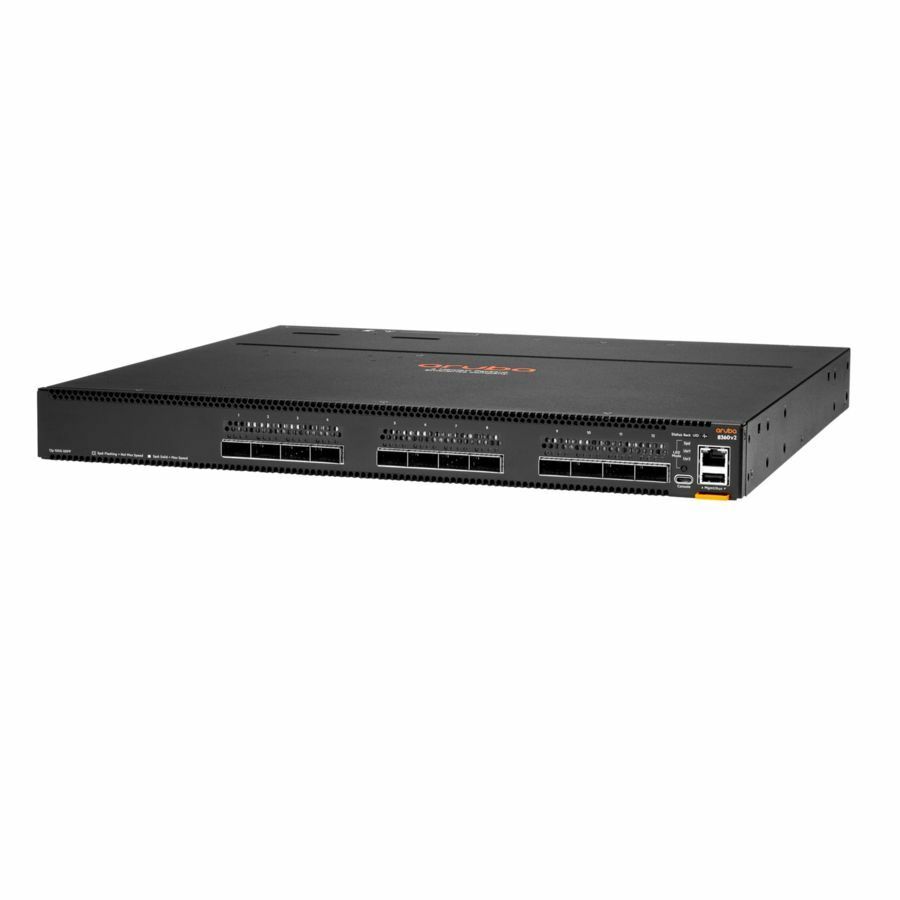
High performance enterprise campus and data center switch.
Features | Maximize your HPE Aruba Networking CX 8360 v2 Switch Series | What's New
- 48-port 1/10/25G with 4 MACsec, 6-port of 40/100G with 2 MACsec (MACsec secured connectivity over untrusted domains)
- High performance fully distributed architecture provides up to 4.8 Tbps switching and 1786 Mpps for forwarding
- Intelligent monitoring and visibility are delivered by the HPE Aruba Networking CX Network Analytics Engine (NAE)
- High availability with industry-leading HPE Aruba Networking Virtual Switching Extension (VSX) redundancy and redundant power supplies and fans
- Advanced Layer 2/3 feature set includes BGP, OSPF, VRF, EVPN, VXLAN and IPv6
- The CX 8360 48 and 32 x 25G port models support low-density MACsec ports and enable secured connectivity at 10GbE and 25GbE over unsecured domains |
Modular cloud-native architecture
- HPE Aruba Networking CX 8360 v2 Switch Series features HPE Aruba Networking CX Switch Operating System (AOS-CX) which simplifies the complexities of managing data center networks with automation options to match your IT organization's operating model.
- It proactively detects issues and speed troubleshooting with actionable insights provided by an analytics engine embedded in every switch.
- REST APIs and Python scripting provide fine-grained microservices architecture enabling full integration with other workflow systems and services.
- Continual state synchronization provides superior fault tolerance and high availability with uninterrupted infrastructure, designed for resiliency and upgrades with zero downtime.
- Advanced Layer 2/3 feature set includes BGP, OSPF, VRF, EVPN, VXLAN and IPv6
HPE Aruba Networking CX Network Analytics Engine (NAE)
- HPE Aruba Networking CX 8360 v2 Switch Series utilizes the HPE Aruba Networking CX Network Analytics Engine (NAE) for advanced telemetry and automation to provide industry-first monitoring and troubleshooting systems that greatly improves network operations.
- The time series database (TSDB) is used to store configuration and operational state to write software modules to troubleshoot problems. This data may also be used to analyze trends, identify anomalies, and predict future capacity requirements.